Summary:
Section titled “Summary:”This standard includes a visual representation of the cIT documentation pyramid including a detailed description of each type of document and naming convention.
Assumptions, Risks, or Dependencies:
Section titled “Assumptions, Risks, or Dependencies:”Assumptions:
Section titled “Assumptions:”There are no assumptions.
Risks:
Section titled “Risks:”There are no risks.
Dependencies:
Section titled “Dependencies:”This standard works in tandem with the Knowledge Documentation. Attached in relationships.
Requirements:
Section titled “Requirements:”NA
Standard:
Section titled “Standard:”All cIT employees and contractors are to adhere to the pyramid, understand the different types of controlled documents and the naming convention of each. See the added knowledge relationship for Knowledge Documentation when creating a new KB article.
External References:
Section titled “External References:”NA
Pyramid Image
Section titled “Pyramid Image”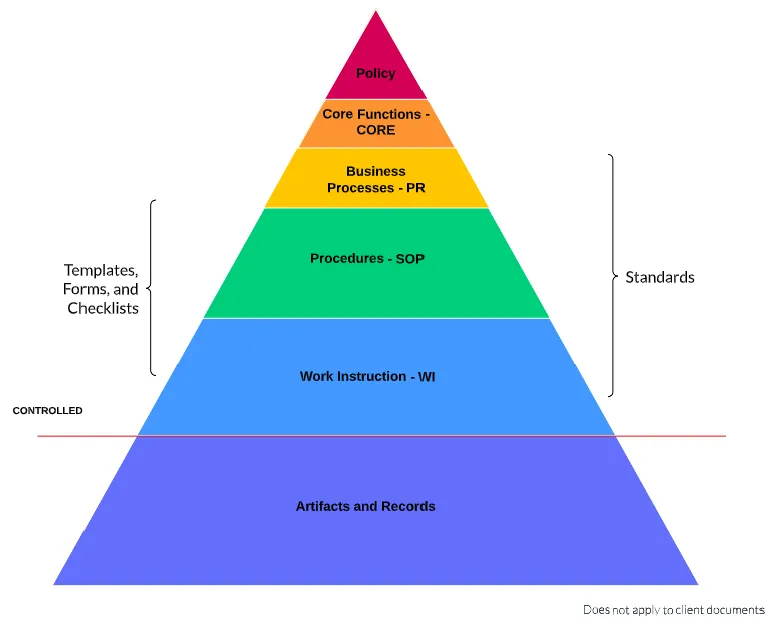
Descriptions and Definitions:
Section titled “Descriptions and Definitions:”- Policy - POL
-
A guideline or statement of position with respect to a given topic that governs at the corporate level.
-
This is not to be confused with client policies.
-
centrexIT has 5 governing policies:
-
Quality Manual
-
Business Continuity
-
Information Security
-
Financial
-
Employee Handbook
-
Created and maintained by leadership team or assigned designee.
-
Naming convention - POL - Name of Policy
-
EX: POL - Employee Handbook
- Core Function - CORE
-
A set of related and interdependent activites that are vital for an organization to meet mission, goals, and objectives.
-
centrexIT has 10 core processes:
-
Accounting Management
-
Continuous Improvement
-
Customer Aquisition
-
Customer Strategy & Relationships
-
Employee Development & Satisfaction
-
Treasury
-
Management Responsibility
-
Product Development
-
Service Delivery
-
Technology Management
-
Created and maintained by the core process owners.
-
Naming convention - CORE - Core Name
-
EX: CORE - Service Delivery
- Business Process - PR
-
A high-level description of a large task or series of related tasks.
-
Typically involves:
-
3 or more medium to large tasks
-
More than 1 person or department is required for completion
-
Includes a time delay of hours, days, or even longer between steps
-
Multiple procedures (SOP) and work instructions are necessary to fully describe it
-
Naming convention - PR - Process Name
-
EX: PR - New Client Onboarding
- Procedure - SOP
-
A SOP is more detailed than a process, but less detailed than a work instruction.
-
Outlines a series of sequential tasks performed to achieve a specific outcome.
-
Typically involves:
-
10 or more separate actions or tasks to complete
-
Steps can be 2 or more levels deep
-
More than 1 person or department is required for completion
-
Completion is done in a continuous timeframe
-
Naming convention - SOP - Verb + Procedure Name (what are you tryng to produce)
-
EX: SOP - Create a Network Assessment
- Work Instruction - WI
-
Is the more detailed description of a task.
-
Explains step-by-step how to perform and complete a task.
-
Typically involves:
-
Fewer than 10 separate actions or steps
-
1 person to complete
-
Performed in a short amount of time
-
Naming convention - WI - Verb + what you are doing
-
EX: WI - Print a Report from Power BI
- Standard - ST
-
A standard is a rule or principle designed to provide consistency to the planning, development, operation, and governance of cIT business practices and IT services.
-
Typically associated with a PR or SOP; however, there can be standards associated with a WI.
-
Naming convention - ST - single area of rule focus
-
EX: ST - Documentation Pyramid
- Records or Artifacts (these are not created in or stored in Halo KBs)
- Output or evidence that a WI or SOP has been successfully created.
Note: Please add KB relationships to core process, process, SOPs or other WIs on the right.